What kind of art do you like?
What is your favorite subject matter?
What is the medium you feel most drawn to, even just as an observer? (Pun not intended.)
These are common questions artists get often (except that last one). They are okay questions, but I don’t really know if anyone truly has any answers for these. Fellow artists— what questions would you ask?
I would like to ask, “What is it you look for in art? What messages do you find yourself drawn to when you go to museums or browse an artist’s website/ gallery?
The sorrow. The pain. The magical/whimsical. These are a main component in the messages/styles I find myself staring at forever and a day: the emotion of an artwork. The emotional conveyed so that we understand it. We connect through it.
“WHY IS ART IMPORTANT?”
I cannot tell you how many times we were asked that in school. Maybe it’s because I am from the United States where their values are that of a dragon hoarding its golden treasure. A treasure that ensures isolation. A treasure that disconnects people. A treasure that does not have a real purpose when kept away. A treasure that does not make sense, for where would a dragon spend gold? It wouldn’t. Even if it could. Greed. It’s just greed.
We get it. All of us. We all have been greedy. Maybe not consistently, but there have been plenty of times with plenty of things outside of greed that we are all “guilty” of.
If you could depict greed, what would it look like based on where you are? If you could depict greed, would you use the rich yellows and ochre of golds or would you choose a sicklier color palette to denote the illness it is?
For me, art is important because it is communication.
Before people created letters, they created pictures. Pictures are the original written language. Pictograms. I feel like that is why art is so incredibly important. I am not educated in multiple languages. I, unfortunately, have a very difficult time adapting to new languages and often struggle hearing and comprehending people in English, my native language. If you wrote or told me vocally that you were sad, but said so in German, Danish, Scottish, Swahili, etc. I might be able to understand you through any emotional cadence, tone, body language. If relying on words— I’d never know.
I don’t need words to tell me your brow is furrows and the outer corner of your eyes squinting more than then inner corners of your lids, or the downcast form of your lips. Perhaps the colors you chose to wear that day (assuming you are caught up on laundry), the positions your body takes on in such lack of spirit.
Art is important because, in a world full of miscommunication and language barriers, it is the most basic form of communication for those with sight. It surpasses the difficulty in translating customs and dialects so much that we even have abstract art! Admittedly, I’m not too fond of abstract art, but there are a few of them I quite enjoy.
I think one of my favorite qualities of art is the forethought. It’s designed. It’s (usually) planned. It’s almost always an example of “think before you speak.” I say almost because I have done art battle with absolutely nothing planned. Haha
As much as I would like to say art is always understood, it’s not. There is still miscommunication within it, but art… is our humanity. It puts you in a first perspective view of another. It puts you in their shoes somewhat, and that view, that experience is amazing. Can be enlightening, even. It can be painful, too. Now we have vast vocabularies to express ourselves and convey what is happening within us and to those around us. It is a way to keep a record that people will perhaps see someday.
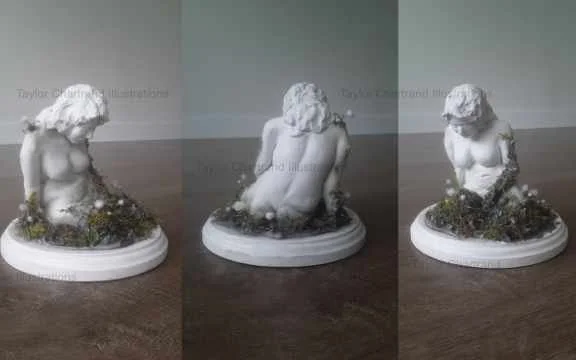
With so many materials to tell it! Charcoal, graphite, oil paint, acrylic paint, acrylic panes, ink, watercolor, encaustic painting, printmaking, sculpture in wood, metal, clay, paper… so many different tools to say what we need to, each with its own influence. For example, if I were to do a piece about a childhood memory, I would like to use encaustic. The wax medium would help me to show the hazy, foggy nature of an old memory that shifts. Something that looks just out of reach. If I want to create an artwork about feeling stuck making wishes and not actually doing anything and how that affect me, I may use clay to represent the heaviness of that feeling of being sad that nothing ever gets done. (Note the photo.) There are other decisions to make in creating the artwork. They greenery being the only real color because that is the only thing growing: wishes. The dandelions fragile like hopes. The decaying form of the body as it does nothing but wallow with want.
So, how about it? What messages do you look for? What messages remind you that we are all far more similar than we think? What does art do for you? Does it matter to you?
~Taylor